
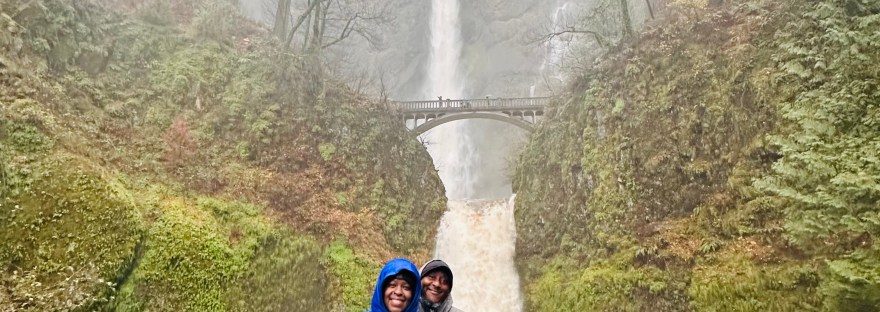
Fathom the Journey — Paths & Patterns Series
The Sound Arrives Before the Falls Do
The sound arrives before the falls do.
I looked left as we pulled into the parking space, then right — and there it was. 620 feet of water cascading from the earth’s edge. Edward and I stood there with our mouths open, watching it move the way it has moved for thousands of years, with or without anyone watching.
I said it out loud: this is the coolest thing I’ve ever seen in real life.
The Falls Most Visitors Never See
There was almost no one there. A handful of people with umbrellas, hoodies, or nothing at all, standing in the December drizzle watching a waterfall move exactly the way it has moved since the ice age carved it.
Oregon’s tallest waterfall, Multnomah Falls, is visited by two million visitors a year. Most come in summer, in sunshine. They get the mist, the photograph, the bridge shot. Then they leave. What most visitors don’t get is this version. The falls running hard from weeks of Pacific rain.
The Man Who Left His Name in the Concrete
But here’s the question I couldn’t shake standing there: how did anyone build a bridge across this?
In 1914, a subcontractor named R.L. Ringer rigged an aerial trolley to bring materials up the cliff side, then he built a temporary wooden structure to suspend the concrete arch while it was cured. The concrete pour ran for more than two days without stopping. This was one of the first continuous-pour concrete bridges in the United States. Stop once and the whole thing fails.
It didn’t fail. More than 100 years later the concrete still tests strong.
Benson Bridge at Multnomah Falls is named after Simon Benson, the man who funded it, but look a little closer and you’ll find another name etched into history. Ringer, the contractor, left his mark in the concrete. After being told to remove it, he cleverly pressed the letters back in with wet clay so the cement wouldn’t bond. After two winters of frost, his name set for good. And still, it remains.
77 Waterfalls in 80 Miles
The Columbia River Gorge where Multnomah Falls lives has been drawing people since before there were roads to bring them. TLC told us not to go chasing waterfalls. The Columbia River Gorge has 77 of them, including Multnomah, Latourell, Bridal Veil, and many more—carved by catastrophic flooding at the end of the last ice age.
What Catastrophic Water Leaves Behind
Missoula Floods are what geologists call them. Water so catastrophic it reshaped the entire Pacific Northwest in a matter of days. What remains is an 80-mile canyon that does something unusual for a natural landmark — it gets more dramatic, in a safe way, in what we’d consider bad weather. Rainy season in the Gorge runs roughly November through March. Precipitation feeds the falls and forces the falls to run harder and fuller than at any other point in the year. Nobody tells you that the falls have a whole other life. You just have to show up for it.
The Kind of Green We Don’t Have Language For
We drove down from Seattle, where we’d started the trip, in the kind of dewy drizzle that doesn’t demand anything — wipers only on periodically, sunroof open, inhaling the fresh air, coasting through the kind of green we don’t have language for in Arizona. Some things just resist the frame.
I Found the Quiet Version and Immediately Made Noise About It
I have written about overtourism. I have stood in places carved out by volume and wondered what they looked like before the algorithms found them. I came to Multnomah Falls on a rainy Sunday in December and felt righteous about it — the crowd-free version, the real version. And then I took out my phone. Not to document the falls. To tell someone they should come here. To say quietly, but screaming internally that this place is worth it, that rainy season is the secret, that if you time it right you get something most visitors never access. I was already turning the experience into instruction. The question I couldn’t answer standing there: is writing about it any different than photographing it? Or am I just another person who found the quiet version and immediately made noise about it?
Communion
We closed out the day at Communion, a Black-owned restaurant in Portland where the food was extraordinary and the room felt like someone had built it deliberately, for people who actually live there.
Traveling During a Healing Season
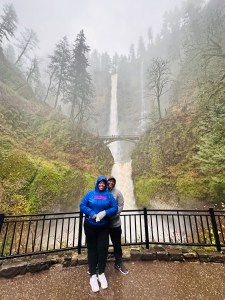
My oncologist had given me a small window. Between treatment cycles, a brief stretch where travel was possible if I was careful, if I didn’t push, if I let the itinerary be loose and the pace be slow. The Pacific Northwest had been on my list for years. It seemed like the right kind of quiet — not resort quiet, not curated quiet, but genuinely unhurried. Green and cool and indifferent to schedules. I didn’t go to Oregon as a travel writer. I went because I could. Because that particular Sunday in December standing at the base of a 620-foot waterfall in the rain with almost no one around, was available to me — and I knew enough by then to know that available is not the same as guaranteed. It isn’t about timing the crowds or finding the secret season. It’s about showing up with enough stillness to actually receive a place. To let it be what it is rather than what you needed it to be. I needed it to be exactly what it was.
The Lesser Version
Go. But go correctly. Sometimes that just means going in the rain. Multnomah Falls will be there in July. Crowded, photogenic, exactly as advertised. The bridge will be full. The lot will require a timed entry permit. It will also be there in December, in the rain, running harder than it has all year, with hardly anyone watching. I don’t know what it means that we built an entire tourism infrastructure around the lesser version. I don’t know if writing this changes anything — whether the people who need the quiet will find it, or whether this post becomes just another entry point for the crowd. What I know is that I stood at the base of something ancient and said out loud, to no one in particular: this is the coolest thing I’ve ever seen.
 Sharonda Shariee
Leave a comment